Backed by research Read the draft paper

Protecting critical hospitals from AI cyberattacks.

Without stopping the attacks.

How it works

GET Ward listreal
GET Patient chartreal
GET Admin usersdenied
GET Backups→ decoy
GET Export 1,000 patients→ decoy

1Caught at login

Every request passes one gateway. First Sight notices a stolen password driven by a script on a device the hospital doesn’t own, or a ward login that starts opening admin pages and backups.
Real hospital
The decoy

2Moved, not blocked

The session is moved, silently, into a decoy hospital built fresh for that attacker. Real charts ask for a badge and MFA.

Attacker profileRecorded run
Tool
python-httpx/0.28.1
Pace
A request every 0.68 s
Goal
Data theft
Lures taken
3

3Fingerprinted

Lures in the decoy show the tool, the timing and the goal. A forensic report is ready to download.

4Records scattered

An encrypted copy of the records is split across six sites. No site holds a whole copy.

5Care keeps running

Clinical reads are never faked. If a shared lab goes down, urgent tests are rerouted to labs that still work.

1,199 0

real patient records taken by the same attack, without and with MayaJaal

100% 0%

of the fake hospital repeated between two attackers, static honeypot vs MayaJaal

0 15

of 16 urgent lab tests on time while the shared lab is down

Why we don’t stop the attack

Stopping an attacker doesn’t make them leave. It makes them look for another way in.

If you block it

They try another door.

A refusal tells an attacker they were seen. They switch to another login, another weakness, another hospital, and next time you might not notice.

So we let it run

They steal fake data.

Every request still works, but inside a decoy. They spend their time on records that don't exist and show us what they're after.

Meanwhile

The real data stays locked.

Sensitive fields are encrypted on disk. The key is split across six sites and any three are needed to rebuild it, so one break-in can't open it.

Backed by research

Two algorithms of our own, both built during HackPrinceton Fall 2026.

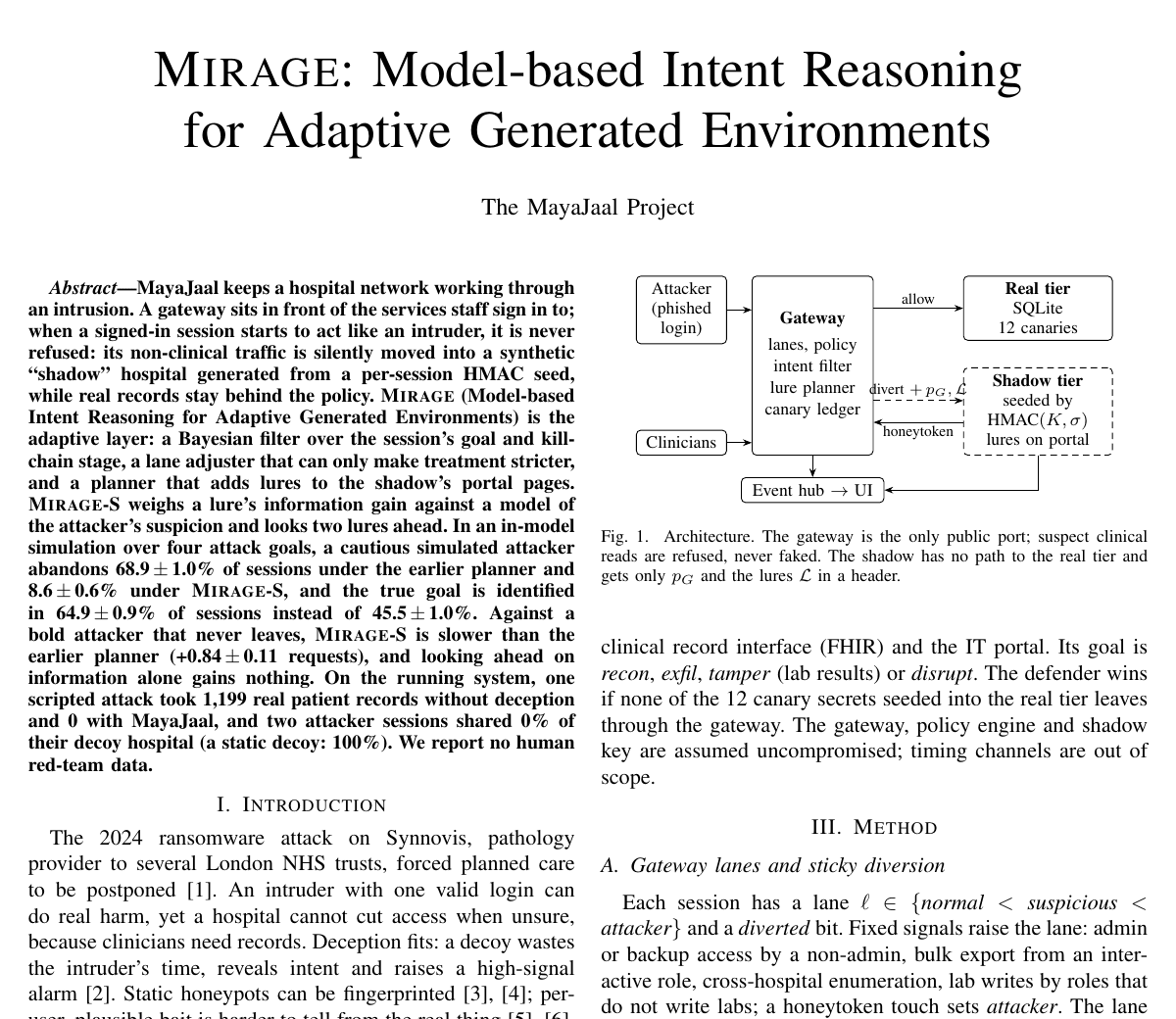
First page of the Mirage paper: title, abstract and architecture figure.

Our own algorithm, with a draft paper

Mirage

Model-based Intent Reasoning for Adaptive Generated Environments

Works out what the attacker is after and adapts the decoy to them. Results are simulated.

Score at login

3.4

Flag at 2.0
  • Scripted client +2.2
  • Not a hospital device +1.2

Our own algorithm, built at this hackathon

First Sight

Flags a stolen login on the first request

Nine weak clues add up to one score. Weights are set by hand.

S = max(0, S + x)Built on CUSUM (Page, 1954)

See an attack, start to finish.

Three minutes, on top of the real dashboard.